
I've built it, run it, lost it and rebuilt it.
I'm Carol Evans. Business Scaling Architect, Media Founder & Host, creator of the Ufinity Framework and the Feminine Leadership Code.
I've spent decades building businesses, leading people, finding opportunities others have overlooked and challenging the way things have always been done.
Through it all, one thing has remained constant.
I've experienced extraordinary success. I've lost things I worked incredibly hard to create. I've taken risks, made difficult decisions and started again.
My belief in what people, and businesses, are capable of becoming.
And I have a rather big ambition of my own.
I want more women building extraordinary enterprises, creating substantial wealth and changing what success looks and feels like for generations to come.
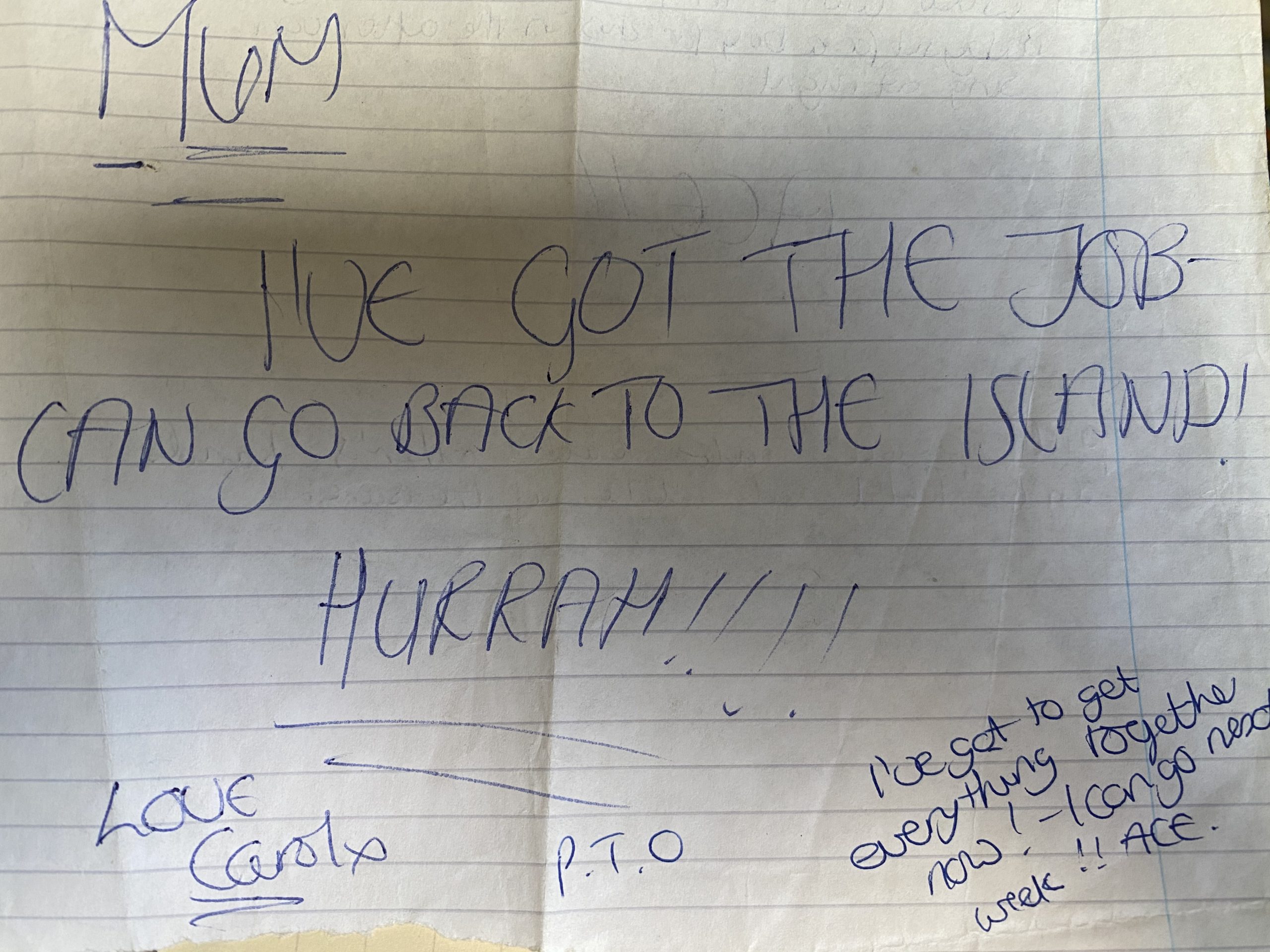

The note I left for Mum when I got myself a six-week summer job. I had no idea how much that decision would change my life.
I was heading for the stage. Business had other ideas.
I started working on a market stall at 12.
I came from a working-class family where hard work wasn't a philosophy. It was simply what you did.
But my dreams were rather different. I loved music. I trained as a singer. I imagined a future in musical theatre, not boardrooms and balance sheets.
Then, at 18, everything changed. After a family holiday, I decided I wanted to work at the hotel on the Isle of Wight where we'd been staying. I got myself a six-week summer job and left a note telling my mum what I'd done.
That little piece of paper, which she still has, marked the beginning of an entirely different life.
Six weeks became years. By 21, I was managing hotels, leading teams and discovering I had an instinctive understanding of business.
I loved recognising opportunities, developing people, improving experiences and finding ways to make things work better.
I hadn't planned to become a businesswoman.
But business, it seemed, had plans for me.
I've never just seen a business for what it is. I've always seen what it could become.
My career eventually took me into senior leadership at The Priory, where I became a Hospital Director responsible for complex operations, professional teams and substantial budgets.
Over the years, I've built, restructured, repositioned and helped transform businesses across different sectors.
I've turned around loss-making operations, removed services that weren't profitable, renegotiated expensive contracts and brought brilliant but disconnected individuals together into effective teams.
I've recognised opportunities to take existing services into entirely new markets. I've found ways to generate income from underused buildings, equipment, expertise and customer relationships. I've created new commercial propositions, developed strategic partnerships and built operating models designed for expansion and franchising.
And I've helped take thirteen businesses to seven figures, including two beyond.
What fascinates me is how often the greatest opportunities are already sitting inside the business. An empty treatment room. An overlooked customer need. A talented employee whose potential hasn't been recognised. An existing service that could be valuable to an entirely different market.
Sometimes it's revenue waiting to be created. Sometimes it's profit quietly disappearing. Sometimes the entire business needs to be reimagined.
Decades of lived commercial experience, leadership and continuous study have given me an almost instinctive ability to understand businesses quickly, recognise their pressure points and identify where the most valuable opportunities may lie.
I don't arrive with a ready-made formula. I see the business in front of me, the potential within it and the person behind it.
Then I help orchestrate the changes that can bring that potential to life.
Who decided you had to start small?
When I eventually left corporate life to start my own business, I didn't see any reason why being a new entrepreneur meant I should have small ambitions.
I went straight out to develop a €16 million destination spa venture. I created the business proposition, attracted exceptional people and secured a substantial investment offer.
Then planning permission was refused.
An extraordinary vision, years of work and a future I'd imagined so vividly disappeared. It was devastating.
But it also taught me something about ambition.
The fact that something doesn't work out doesn't mean you were wrong to dream that big.
I've known the exhilaration of seeing extraordinary potential in something that doesn't yet exist. And I've known what it feels like when circumstances bring everything to a halt.
That's why I don't romanticise entrepreneurship. I understand the commercial realities, the difficult decisions and the personal cost.
But I still refuse to believe that women should measure their ambitions against what feels familiar, comfortable or socially acceptable.
Being brilliant at what you do doesn't make you a brilliant leader.
Before I left corporate life, I worked with an exceptional clinician who struggled profoundly with leading people. I remember leaving meetings in tears.
Here was someone with extraordinary professional knowledge who didn't seem to understand the effect their leadership was having on the people around them. That experience stayed with me.
Because I've seen what happens when organisations are filled with talented individuals who are managed as though they're simply there to complete tasks. People who aren't encouraged to think beyond their job descriptions. People whose ideas are never heard. People with remarkable abilities that nobody takes the time to discover.
And I've seen the difference when leadership changes.
I believe people should have the opportunity to become more of who they're capable of being through their work, not less.
Imagine a world where more people actually looked forward to Monday morning. Where they felt seen, trusted, recognised and genuinely involved in creating something meaningful.
I believe that when businesses develop people instead of simply managing them, extraordinary things become possible. This conviction is central to my Feminine Leadership Code: leadership that combines commercial intelligence with humanity, intuition, accountability and the courage to see potential in others.
We've spent generations surviving. I want women to build empires.
I come from a long line of hardworking women. Women who knew how to make ends meet, stretch what little they had and do whatever was necessary to keep their families together.
I honour their determination. But I also question the conditioning that taught so many women to be grateful for what they had, put everybody else's ambitions first and keep their own dreams sensible.
For generations, women were expected to build homes rather than empires.
I want women to know they can build both.
That they can love their families, enjoy their femininity, experience beautiful lives and still create businesses of extraordinary scale and value.
Successful businesses create employment, develop talent, support other enterprises and generate wealth that can extend far beyond the person who founded them. I believe women have extraordinary potential to contribute to that expansion.
But I don't want us simply replicating the leadership models we've inherited. I want more women building ambitious, profitable, visionary organisations where people can flourish, where opportunity is created and where commercial success and humanity aren't treated as opposing forces.
My mission isn't simply to help women earn more money. It's to help more women create businesses that change what's possible for themselves and for others.
The women who came before us.
There's something rather wonderful about discovering the stories of the women who came before us. My aunt has spent years tracing our family history through the Fowkes ancestry, and recently uncovered a connection to the Tudor court.
According to her research, our family descends from Alice Shelton, whose brother, Sir John Shelton, married Anne Boleyn's aunt, also named Anne Boleyn. The couple were entrusted with the household of the future Queens Mary I and Elizabeth I.
But what interests me most isn't royal association. It's how different the opportunities available to women have been throughout history, and how much of our own future we now have the opportunity to shape.
Five weeks. Seven places. And some rather big questions.
A few years ago, I took myself off on a five-week solo adventure along the South of France. I began in Menton, travelling along the Riviera, stopping in different places and exploring wherever curiosity took me.
I walked for miles. I caught little buses into the mountains. Wandered through unfamiliar streets. Sat quietly in extraordinary landscapes. Sometimes I simply stopped and looked.
I remember sitting in front of the mountains, feeling so deeply connected to the landscape that the distinction between myself and everything around me seemed to disappear.
But beneath all that beauty, I was asking myself questions I'd spent much of my working life being too busy to answer. Who is Carol Evans? What am I truly here to do? What do I want my life to feel like? And what legacy do I want to leave behind?
I began questioning how much of the life I'd created had come from my own desires, and how much had been shaped by the expectations I'd absorbed along the way.
Because we can become exceptionally good at succeeding in lives we've never consciously chosen. We pursue the next target, the next achievement, the next financial milestone. We become comfortable. And sometimes that comfort becomes the very thing that stops us imagining anything more.
That's why the first question I ask my clients isn't how much money they want to make. It's what they want their lives to become.
Because once we understand the destination, we can begin designing the business capable of taking them there.
Think like a CEO. Feel like an artist. Lead like a woman.
My work brings together two things that have always been part of me. A deeply commercial mind, and an equally deep love of creativity, beauty, expression and life.
I'm a trained singer and photographer. I love music, art, movement and the way a beautiful experience can awaken something in us. I've never understood why women should have to suppress these parts of themselves to be taken seriously in business.
Through decades of experience and continued study, I've developed two frameworks that bring these beliefs into my work.
The Ufinity Framework connects vision, mission and purpose with leadership of self, others and the business, creating the foundations for greater income, impact and influence. It begins with a simple principle: your business should be designed to deliver the life you want to live, not demand that you give your life to it.
The Feminine Leadership Code explores how women can lead through their own strengths, combining strategic thinking with intuition, presence, creativity and an ability to bring out the best in others.
We can be strategic and sensual. Disciplined and imaginative. Ambitious and gloriously alive.
That's what I mean by fabulosity. Not superficial glamour, but the confidence, freedom and pleasure of creating a life and business that are unmistakably your own.
Making it normal. More women telling their stories.
Alongside my business advisory work, I'm a trained photographer, video producer and host, and the founder of Iconic Impact Studios.
I created Iconic Impact because I want to change the stories we see about women in business. I want it to become normal to see women building substantial enterprises. Normal to hear them talking confidently about wealth, investment, leadership and ambition. Normal to celebrate the difficult decisions, doubts, reinventions and risks that brought them there.
Not carefully polished success stories that hide everything uncomfortable. Real stories. The woman who nearly gave up. The founder who had to let go of being the expert in everything. The leader who found the courage to trust other people with something she'd spent years creating.
Because when women see what's possible for other women, they can begin to imagine something more for themselves.
We were the women who went first. And we made it normal for those who came after.
Wherever I want to be.
My chapter in Women Who Are Not Willing to Settle, the collaborative book that reached No.1 on Amazon.
It's the story of losing my dad, of a failure that very nearly tore my life apart, and of the one belief that carried me through.
I always knew I was born for more. You know you are too.
Download my story free, with the lessons I'd want you to take from it.
The life you want to live. The difference you want to make. The legacy you want to leave.
Today, I work with wildly ambitious women who've already created something valuable but know there's so much more potential waiting to be realised. I help them reconnect with what they genuinely want, see opportunities they've overlooked and orchestrate the commercial strategy and leadership required to make their next chapter possible.
Because I don't believe success should be measured simply by how much you've built. I believe it should also be measured by what that success makes possible. For you. For the people you lead. And for the generations who follow.